
PART I — CLARITY
Chapter 7 of 10 · Online sample 7 of 10
Dopamine
The next major player in behaviour is dopamine. You can think of dopamine as fuel for the fire of what you do and don’t do. This subject is explained beautifully in the book The Molecule of More by Dr Daniel Z. Lieberman and Michael E. Long, which I highly recommend reading when you have the capacity.3 To get started, though, we just need a rough understanding of how this system operates—specifically from our perspective.
Have and Want
Essentially, an individual’s possessions—both real and abstract—can be separated using a simple paradigm: the things you have and the things you don’t. It follows, then, that the brain has evolved two modes of operation for the purpose of each. One mode deals with what you have, the other with what you want. And because there are no other options, these two modes collectively form the totality of your behaviour. That’s why this matters.
For simplicity, we’ll call these two modes ‘have’ and ‘want.’ In ‘have’ mode, you operate within the domain of what you already possess; in ‘want’ mode, you identify and acquire the things you want but don’t yet have. Simple. The distinction is that identification, intention, and action are required to transfer the desired from ‘want’ to ‘have.’ Enter dopamine.

By definition, the things you have are here in the present moment. The things you want can only be had in the future. In between, you have to get up and make things happen. Only when the desired enters your possession do you finally have what you want. Having what you want then extinguishes the original desire.
Your brain and behaviour switch between these two modes in a balancing act of sustaining yourself with what you have and getting more. In theory, the system should self-regulate, but for the alcohol-dependent, you’ve fallen off both ends. The see-saw may have been rigged from the start—or it’s been damaged by daily use—but either way, you’re going to have to supervise until you can restore some kind of balance.
A Never-Ending Cycle
You can think of the system as a repeating cycle. That’s how it’s supposed to function, anyway. Sometimes, there’s a glitch in the cycle, though, which is the crux of our problem. Let’s understand it as a functioning system first.
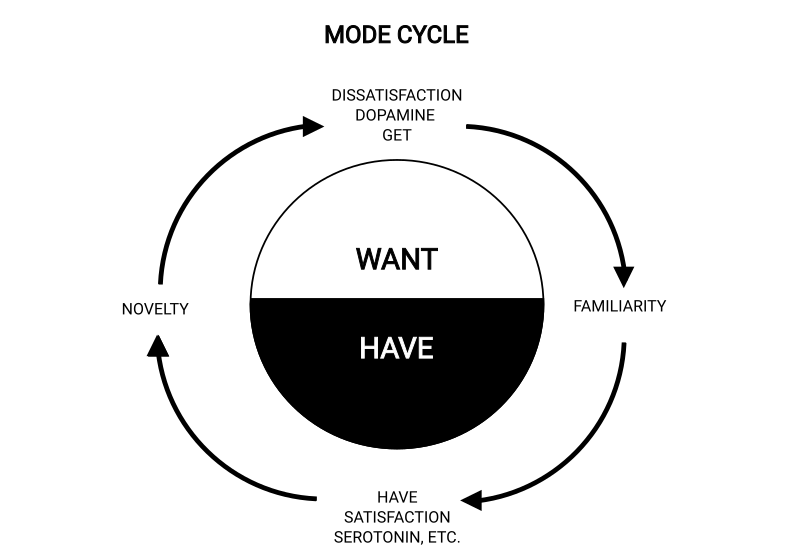
At any point in the cycle, we operate either in the ‘want’ or ‘have’ mode. We continue to do so until conditions send us back toward the other. And so we continue, going around in circles, flipping from one to the other.
Have Mode
The ‘have’ mode operates when we are engaged in the present moment. It is overseen by neurotransmitters, such as serotonin, endorphins, and what are known as endocannabinoids. (The details are not particularly important, but rather the overall concept.) Because this mode of operation is configured for the present moment, the pathways and neurotransmitters facilitate a feeling of contentment and satisfaction. These states oppose mental projection into either the past or the future. Examples of being in this mode include engaging in a good conversation or listening to music that makes you forget yourself and time.
Want Mode
The ‘want’ mode is very different and seemingly more complex. First and foremost, when this mode activates, it draws you out of the present and thrusts you mentally into a future projection of possibility. The ‘have’ mode stands down.
This mode is fuelled by the neurotransmitter dopamine. We can also refer to this mode as the dopamine circuit, which has the opposite function to the apparatus of the ‘have’ mode: it makes us dissatisfied with the present moment and propels us toward a future outcome.
For evolutionary purposes, this system gets us the resources we need for survival: food, reproduction, and so on. The resources we need—or perceive we need—in modern societies are much more complex. The ‘want’ mode isn’t designed for such rich environments, so herein lies the potential for things to go awry.
Activation of this mode (dopamine release) occurs when you experience an element of excitement in your world. This happens when you identify an item of novelty or possibility in your physical or mental environment. Your subconscious mind continuously scans and maps your environment, and a flag goes up whenever it identifies a contrast between the known and the unknown. When you encounter something new or unexpected, it signifies possibility: the potential of resources directly or the means to obtain or maximise resources indirectly. This sets the dopamine-driven functioning of the cycle in motion. From here, alert and motivated, you investigate, strategise, and extract—where possible—what you can.
Once you exhaust all possibilities and the new becomes normal, dopamine has done its job. The dopamine circuits shut down, returning you to ‘have’ mode. You stay there until you encounter the next deviation from the known and are thrust into ‘want’ mode again. That is, under normal circumstances.
Imagine being lost in the desert, and you catch a glimmer of the sun’s reflection in what looks like water in the distance. Possibility! Is it? Isn’t it? Despite being tired and exhausted, you sprint as fast as you ever have and jump into crystal-clear water when you arrive. You drink till your heart’s content, and you can drink no more. The dopamine has done its job, and you’ve secured a new resource. You know where it is now, and while you might need it again, you’ll never sprint toward it like your life depends on it. That was the dopamine.
Dopamine Made Me Do It
The behaviour required for survival doesn’t necessarily align with what you like, especially in the long term. The system fulfils its survival requirements now; you’re alive to deal with the unintended consequences later.
An obvious example of this disconnect is sugar—a rare energy source until relatively recently. Your dopamine system drives you to binge on it because it perceives it as scarce. You might not have access to it again anytime soon, so you’d better stock up.
Today, sugar is abundant, so binging on it provides no survival advantage whatsoever. Quite the opposite: it’s unhealthy. You might survive today, but what about tomorrow? When you eat too much, you gain weight and increase various health-related risks. The myopic dopamine system presses on and makes us want it now, whether we need it or not. Over time, the consequences of overeating become noticeable, undesirable, and in conflict with the immediate priorities of the dopamine system. Do you like this? Probably not. And so the difference between ‘want’ and ‘like’ becomes evident. The same dynamic applies to alcohol: even when its effects are clearly ruining us, the wanting does not subside. While sugar provides perceived physical sustenance, alcohol provides emotional sustenance.
Unfortunately, the dopamine system isn’t voluntary. It is completely reactionary, and whenever it fires, you are in it for the ride, whether you like it or not. You go through the motions until you get what you want, or the dopamine burns itself out and gives up. When the dopamine subsides, we are left with the fruits of our dopamine-fuelled behaviour as we transition back to the ‘have’ mode.
Eventually, most people reach a threshold—enough is enough. The dopamine stops flowing, and we stop. The bad news for the dependent is that dopamine just keeps coming. The system doesn’t recognise ‘enough.’ It never shuts down, and we get stuck in ‘want’ mode. By definition, this mode is not, and cannot be, satisfied. That’s not what it’s for. And because the dopamine never stops, away we go. It only ends when it’s no longer possible to get what it wants. You run out of alcohol, run out of money, or pass out. Even then, you’re left with cravings as the dopamine reluctantly skulks away. What you wake up to is deep dissatisfaction.
When we are forcibly returned to ‘have’ mode, the outcome is misaligned with the dopamine promises. It was never physically or mentally healthy to want or do what we did. We neither needed nor liked the outcome; we only wanted it. The gap between just one drink and waking up after passing out is filled with promises of ‘one more won’t hurt.’ This is a very revealing phrase: we go from ‘a drink would be nice’ to ‘one more won’t hurt.’ Dopamine carries us across the line of sensible to harmful, which is then rationalised by the conscious mind.
Exposing the brain to such extreme levels of intoxication throws normal brain function into a state of imbalance. The short-term fix for the discomfort is to go again. So you do. The brain and body barely have time to rest and recalibrate before the whole cycle fires into motion again—each episode taking you further and further away from a state of balance and general well-being.
At first, it’s just the link between consumption and dopamine that becomes established and habitual. Once entrenched, together they then become associated with almost everything: every circumstance, feeling, person, mood, emotion, food, activity, and so on. Ultimately, the dynamic flips and circumstances become the trigger. You now have conditioned behaviour.
My suspicion is that because substances like alcohol provide an artificial sense of connection and acceptance, the dopamine system can’t tell the difference and makes you want it in an attempt to meet these survival needs. But because it’s an artificial sense, the dopamine circuit doesn’t fully recognise it as the real thing. If it were substantive, the system would eventually recognise it as such and power down. Instead, the system attempts to compensate for this inauthenticity and gets stuck in perpetual motion.
Dopamine vs Dopamine
The good news is that you can and do want different things. You can want diametrically opposed things. If you are reading this, then you clearly don’t want to be drinking. But also, you do want to drink because you do. We, therefore, have an interesting conflict where dopamine appears to be in direct competition with itself.
Essentially, the winner is whichever desire is stronger, although what exactly defines strength in terms of dopaminergic desires is complex. There are many factors: time, place, energy levels, environment, people. It’s difficult to know and understand them all. To complicate matters, they’re dynamic, too: a factor’s weight shifts in context. Observation of yourself, your behaviour, and these competing desires will help you to understand them. As we will see later, awareness is the first step. Like a muscle, you can then exercise and strengthen healthy desires and let the undesirable ones atrophy.
The part of you that wants to stop is already ascending, and it’s dopamine compelling you to keep reading. You see the possibility of something better. Dopamine will continue to propel you forward because you want it. From here, you just need to accumulate enough knowledge and experience to strengthen that desire and overcome the other—permanently.
The Two Circuits
It’s important to understand that the dopamine circuit comprises two sequential but distinct functions. Each of these functions performs a different role in the act of getting something. Understanding this structure will help you to weaponise the dopamine system against itself and put you in a position of strength moving forward.
Desire Circuit
The first of the two functions is called the dopamine desire circuit. The desire circuit is the part of the dopamine system that involuntarily fires in response to certain stimuli. (You can consider this a subset of the subconscious mind.) When the desire circuit activates, dopamine draws your attention, focuses the mind, and produces desire for a particular object or outcome. It has no plan for getting whatever it has set its eyes on; it just stimulates pure desire for whatever it is. ‘Get me that.’
When it comes to competing desires, a weighing process takes place. The relative weight of contradictory desires—pulling in opposite directions—depends on the wider context and various other factors.

The desire to drink is heavily influenced by factors such as who you are with, where you are, and how you feel. These elements are bundled together and determine the weight of that desire at that time and in that context.

One of the two conflicting desires outcompetes the other, and the scales tip in its favour. The winning desire is then fed to the second of the two functions.
Control Circuit
The second function is known as the dopamine control circuit. (You can consider this a subset of the conscious mind.) Once the desire has been stimulated, the job of the control circuit—again powered by dopamine—is to work out the following:
- Whether it’s worth it.
- How to get results.
- How to maximise those results.
It thinks, strategises, plans, and implements whatever it deems to be the best course of action. The following illustrates this relationship: the dominant desire circuit decides what it wants and instructs the subservient control circuit to go and do its bidding.

You can think of the desire circuit like a child who sees a new toy advertised on TV. They identify it as something they simply must have, even though it costs a fortune. They then relentlessly pester their parents to get it. The parents (the control circuit), not wanting to upset the child, will look into whether they can afford it, where they can get it cheapest, whether discount codes are available, and so on. If they can make it happen, they’ll execute and get the toy. If the cost is too high, or the sacrifice elsewhere is too great, they’ll back out and deal with the child nagging. A nagging child is easier to deal with than Child Protection Services knocking at your door to find out why you aren’t feeding them.
If the desire circuit determines that it wants to drink more than not, the control circuit goes to work to make it happen: ‘Where can I buy alcohol? Do I need money? How can I get there?’ If the desire circuit determines that it doesn’t want to drink more than it does, it goes to work to make that happen instead: ‘Where can I get help? What excuse can I give for not going to the party? How do I get to sleep without a drink?’
Cooperation
So basically, that’s what’s going on here. Dopamine and its related systems wield significant influence on your behaviour, and this is how. Now that you understand, you can once again aim to cooperate with this system rather than fight against it. You can incentivise it to want what you really want—not whatever takes its fancy. Otherwise, it will just keep doing what it does, and you’ll be going along for the ride.