
PART I — CLARITY
Chapter 6 of 10 · Online sample 6 of 10
You
For the sake of simplicity—and to provide us with a useful model of our behaviour—we will break ‘you’ down into three components: the two minds and the body.

The two minds are specifically the smaller conscious mind (black circle) and the larger subconscious mind (white circle).
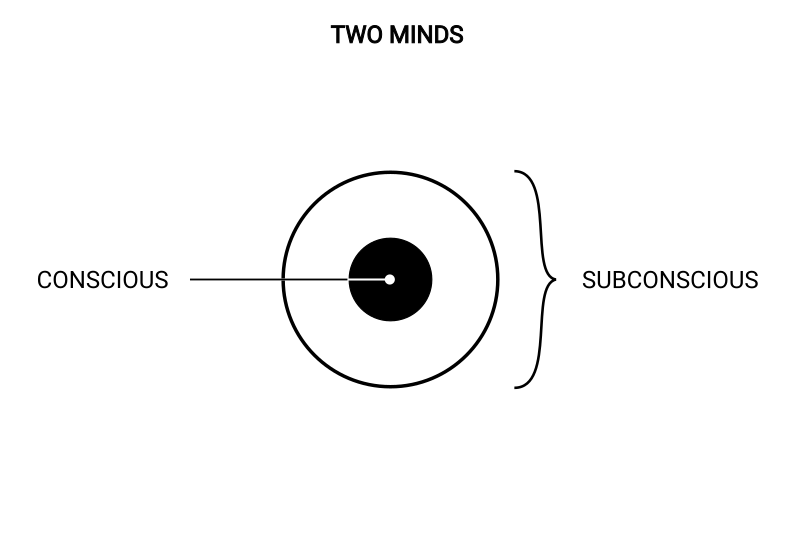
Together, these three elements instigate, engage in, and experience your behaviour.2 Let’s examine each element and its role.
The Body
The simplest to describe is the body. It’s just a passive vehicle—a vessel for the two minds. In the context of addictive behaviour, it’s a lackey running errands, such as fetching another bottle of wine before the shop shuts. The same motivation to go to the gym the next day is mysteriously absent. From the body’s perspective, one of these choices leads to a dreadful hangover and a shell of a person. The other promises a rush of endorphins and a healthier, stronger version of itself. It’s not the body that’s calling the shots, though: it does as it’s told and deals with the consequences.
This is not to say that the body isn’t crucial in recovery. It’s very important. Improving the health of the body feeds back into the health of the minds and the control of behaviour. Working with the body is downstream of the two minds, though. The body won’t choose to improve itself. It can’t.
Conscious Mind
The conscious mind is the one that you are using to read these words. It’s the ego—the one you use to reason with. It’s the voice in your head that says, ‘I’m never drinking again.’ It handles basic arithmetic, such as 2+2, and if you consciously think, ‘scratch my nose,’ your body makes it happen.
The conscious mind is profoundly useful but doesn’t encompass your entire being. Rather, you should view it as a tool for specific functions and tasks. It’s certainly not the go-to for solving long-term behavioural issues. In reality, it influences only about 5% of behaviour. That’s not a lot, considering how often people identify exclusively with their conscious minds.
The conscious mind has flaws, too. It has limited bandwidth (processing speed), commonly understood to be just 40 bits per second. It’s also single-threaded; it can only process one task at a time.

Another weakness is that rationality—its speciality—isn’t always the right tool for the job, and it doesn’t like to step aside. At this point, the conscious mind fully recognises that your behaviour is out of control, but it operates solely on what it has encountered in the past and present. It can project and strategise into the future based only on what it knows and has experienced. This is a crucial point because when you’re trying to stop drinking without a broader strategy, you’re asking your conscious mind to do something totally new—something it’s never done before nor knows anything about. It’s like asking you to perform brain surgery. Unless you’re an actual brain surgeon, it’s going to be a disaster. It needs help.
Subconscious Mind
The subconscious mind is a fundamentally distinct entity. And it’s a big one. It’s the majority shareholder in your decisions and behaviour. It’s responsible for involuntary actions like regulating your heartbeat, blinking, breathing, and generally keeping you alive and safe from danger. Continuously active, it generally operates beyond the conscious mind’s awareness and drives about 95% of behaviour. It likes to operate in the familiar, favouring what it knows to be safe and comfortable. Unfortunately, for you, what it knows to be safe and comfortable is alcohol dependency and everything that goes with it.
How did it conclude that this behaviour is a smart thing to do? In a nutshell, the answer is ‘environment and conditioning,’ but let’s break it down into its core elements:
- The subconscious is inherently fixated on safety.
- It is deeply social in nature.
- It perceives safety as alignment with the larger social group.
- Your larger social group (society) likes alcohol.
- Your subconscious aligns with that.
The subconscious constantly scans its environment with a bandwidth much larger than that of the conscious mind. It is commonly estimated to process about 11 million bits per second in parallel. That’s huge. And the conscious mind isn’t even really aware that it’s happening.

Utilising this vast amount of information, the subconscious functions as a scale, weighing all environmental content. It then tallies the most repetitive content in its surroundings and mimics it. That way, it fits in. It’s safe from the unknown and rejection.
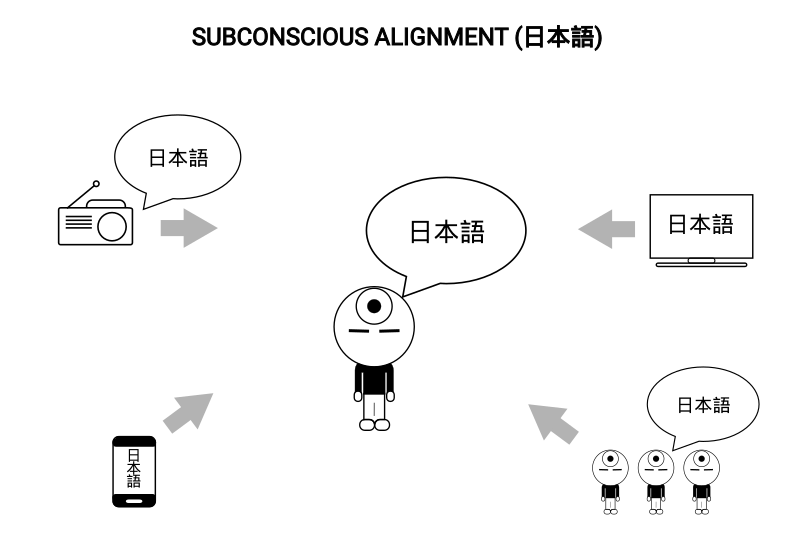
It’s pretty obvious, really. Imagine you were born and raised in Japan. You were surrounded by all things Japanese: your parents, your culture, music, TV, smartphones, everything. And so, you, too, would be aligned with being Japanese.
Children born into Japanese families don’t randomly grow up French, nor do children born into French families randomly grow up Japanese. They simply aren’t exposed to that kind of input, so the subconscious has nothing to mimic. Of course, nationality is a bit of an exaggerated example. But it’s the same principle at work with customs such as drinking: grow up with friends and family that drink, see it in films and on TV, celebrate your peer group’s drunken behaviour. Mimic it all. Fit in. Be safe.
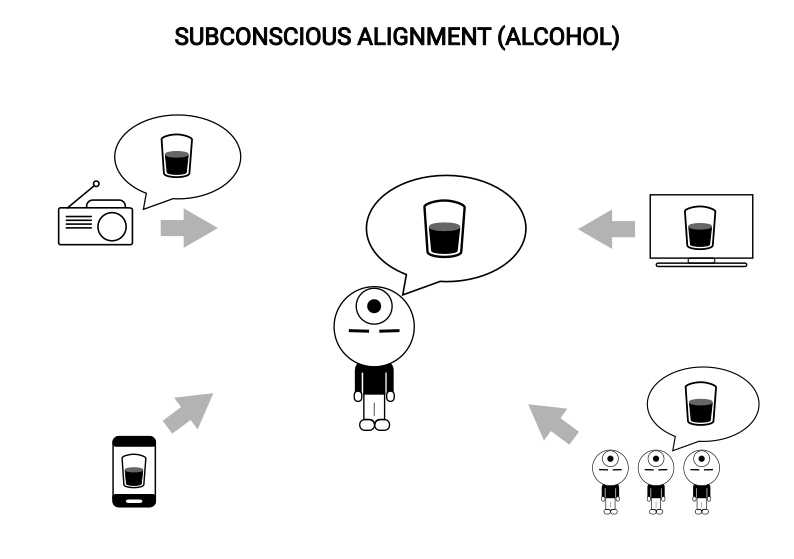
Consider all the nights out, pub visits, weddings, parties, weekends, sporting events, concerts, and much more. Collectively, these experiences carry a huge amount of weight, strengthening the subconscious mind’s resolve to perpetuate the same behaviours. ‘This is what we do.’
Trying to override such deeply ingrained programming with conscious intention alone is almost always ineffective in the long run. Eventually, the subconscious mind exerts its influence and floats a thought into the conscious mind, ‘Just one won’t hurt.’ The conscious mind perceives and rationalises the idea as its own, and the body acts it out as a behaviour. Back to square one. Where was the rationality? Disarmed, disabled, and deluded. Again, it’s not the right tool for the job.
The conscious mind has difficulty accepting this because it has a humility problem. What has to happen to change all of this is not the conscious mind making the decision to stop; your conscious mind needs to grasp these dynamics and then collaborate with the subconscious. By capitalising on the strengths of each and working around their shortcomings, you can develop a more effective strategy for altering behaviour. Or, in other words, you need a team.
So, for the sake of the conscious mind, I will repeat this once more: conscious ‘you’ is responsible for only 5% of behaviour. You contribute very, very little to your manifest reality. The best contribution you can make is to stand aside and start working with the subconscious mind. If you want change, that’s who you need to convince.

The Sum Total
So, that’s ‘you.’ With the subconscious sitting in the big chair as command and control, the three elements intertwine with each other and the external world to create your overall state. ‘State’ generally refers to your condition—both physical and emotional—at any given point in time. The two are, however, inextricably linked: emotional states impact physical ones and vice versa.
Dominated by the subconscious, you’ll move in and out of different states for various reasons, both internal and external. These states then influence your behaviour and, subsequently, your actions. The total of these actions creates your manifest reality.

The Battle of Behaviour
For most of your life, you weren’t even aware a battle was brewing. Your conscious mind thought that going out and getting wasted with your friends was an excellent idea. It was a badge of honour to down several shots, and because all of your friends were doing it, your subconscious was into it, too.
Your conscious and subconscious minds were aligned, and they were basically in cahoots to beat you up. Behaviour was firmly balanced towards drinking.

This dynamic continues until the damage hurts, and it’s no longer funny. The conscious mind eventually realises it’s got a problem: it’s in the cage with a 500-pound gorilla, and it likes to play. You need to put away the toys, but every time you put one away, the gorilla gets two back out again.
Behaviour is still firmly balanced towards drinking, but hope is here. The seed of the great comeback is the split between conscious and subconscious intention.

Now that you know what you’re up against, you’re beginning to realise that a battle of pure strength is probably a losing one. The good news is that now the conscious mind is awake to what’s happening, it can fight back. It just needs a game plan and the will to see it through.
Where do you start? Dopamine. It’s what the gorilla eats for breakfast.