
PART I — CLARITY
Chapter 8 of 10 · Online sample 8 of 10
The Higher Brain
Willpower seems to be noticeable in its absence only. A lot is riding on it to do some of the heavy lifting—especially at the beginning—so it needs to make a comeback. For this to happen, though, we need to understand how it operates and where it’s gone. Let’s take a look.
Higher Brain and Limbic System
To understand willpower, we can use a model of the higher brain and limbic system. Although the brain is a much larger and more complex organ, this dichotomy serves our purpose here perfectly.

The higher brain—also known as the frontal lobe—is located just behind the forehead, and the limbic brain is located behind that. The responsibilities of these regions are as follows:
- The frontal lobe is the seat of higher-order thinking, such as intellect, judgement, reason, and, of course, the will. It is also responsible for impulse control.
- The limbic brain is responsible for processing emotional and feeling-based responses.
When we encounter a new situation, we have a high degree of conscious choice over how we respond. The frontal lobe plays a significant role in that choice and, therefore, the outcome. This is the will in action. But when we encounter the same or similar situations thereafter, we become increasingly likely to respond in the same way. A habit is just behaviour that is handed over to the automatic.
What’s more, these behaviours are registered alongside associated feelings and emotions. When the behaviours become habitual, choice (will) takes a back seat. At this point, behaviour is more likely to be directed unconsciously—and emotionally—by the limbic brain. It’s not that we don’t have free will over such choices; it’s just that a path well-worn becomes easier to take. So unless willpower re-enters the equation, the neural pathways that have been carved out take over. And the more you take a path, the more willpower (energy) you need to make and take a different one.
Neural Pathways
The term path is quite literal: the transition to habitual behaviour takes place via the formation of structural pathways in the brain.4 To illustrate this, consider the following simplification.
We encounter some kind of situation for the very first time. This input is received by the brain cells (neurons), and we can respond in various ways.

At this point, let’s say we choose response A. The neurons representing this behaviour connect via neurotransmitters and form a neural pathway.
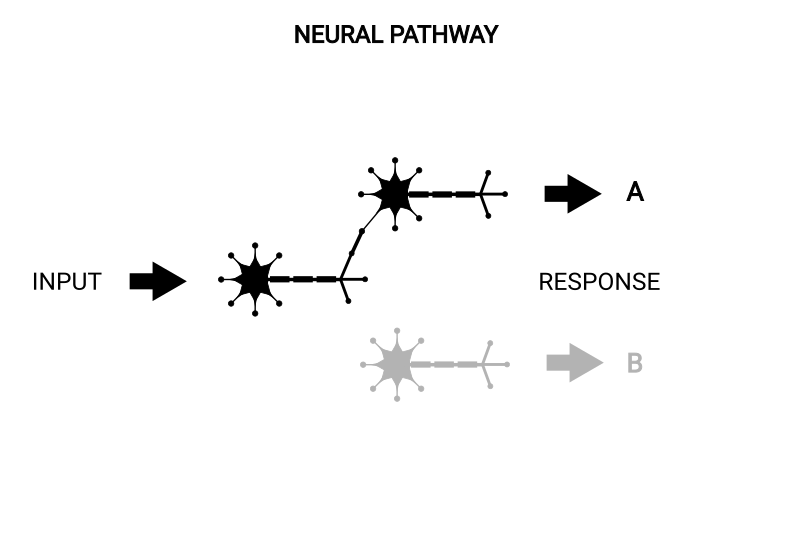
The more that response A is repeated, the stronger and more established the pathway becomes. At the same time, the other options are more or less fenced off. As this goes on, it takes more and more willpower to change it.
This is also how we learn. On a larger scale, when we encounter alcohol (input) and choose to drink (response), we subsequently experience relaxation or euphoria (outcome). These relationships begin to interweave and interconnect into a much larger network. We then quickly learn that when we encounter an uncomfortable emotion—like anxiety—alcohol can relieve it because it causes relaxation. Anxiety is the input; drinking is the response. Before you know it, you have an array of uncomfortable situations for which the conditioned response is alcohol. This is how associations get wired up in your brain as neural pathways.
The good news is that these established pathways can be changed.5 Throughout its entire life, the brain retains its neuroplasticity, so you can teach an old dog new tricks with the will to do so. To do that, though, we need our higher brain operating at peak performance. This leads us to our second problem: the health of the higher brain.
Degradation of the Higher Brain
Parallel to this is the self-inflicted degradation of the higher brain. The higher brain functions fully when it’s in a healthy, stable environment; when conditions are adverse or polluted, it becomes compromised. Drinking alcohol is an obvious reason for a degraded environment, but there are many other contributing factors: stress, late nights, lack of exercise, and so on. Unsurprisingly, they all go hand in hand with alcohol and collectively create a self-reinforcing feedback loop. They simultaneously degrade the higher brain and compromise your ability to resist them. It’s a classic vicious cycle.

In alcohol dependency, you’re on a physical and emotional roller coaster. When you’re in this state, the frontal lobe struggles, and behaviour defaults to the limbic brain and established pathways. There’s no mental energy to do otherwise, so you just run on destructive auto-pilot.
Again, the good news is that we can unwind all this and set the cycle in reverse. How exactly we do that, we’ll cover later.